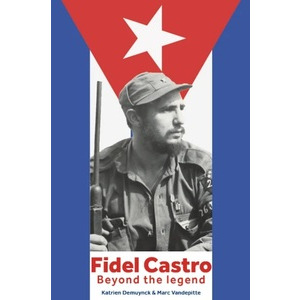
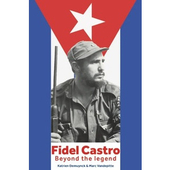
KATRIEN DEMUYNCK and Marc Vandepitte have captured the stature, intellectual brilliance and revolutionary achievements of El Comandante Fidel Castro Ruz. But Fidel Castro: Beyond the Legend also offers an insight into Fidel the man, his personality and motivations. Supported by a foreword from journalist Ignacio Ramonet, this book shows how, under Castro’s leadership, a small Caribbean island became a country of socialism, sovereignty and peace.
Demuynck and Vandepitte trace Castro’s journey from childhood in Birán, where his early environment forged his moral compass. Growing up on his father’s estate, young Fidel was aware of the exploitation of sugar cane workers and Haitian seasonal labourers by US-owned companies. When he defended Serrucho, a Haitian worker being beaten by a guard, Fidel refused to step aside even when the guard drew his revolver.
The authors capture Castro’s political awakening at the University of Havana and his transition from radical student to rebel leader. After graduating, his principles led him to reject a highly paid career to establish himself as a lawyer for the poor, at great sacrifice to his family. During these years of study and political activism, he became convinced that a decisive break with the system was necessary.
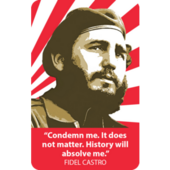
The 1953 attack on the Moncada Barracks failed but became the moral starting shot of the Revolution. On trial, Castro transformed his defence into an indictment of Batista’s regime, culminating in the speech known as “History Will Absolve Me”. In prison, he founded the Abel Santamaría Ideological Academy, transforming his cell into a school of political education.
After the disastrous Granma landing and ambush, his declaration at Cinco Palmas – “Now we will definitely win the war!” – testified to his resilience. The chapters on the Sierra Maestra show how Castro forged a bond with the peasantry through revolutionary discipline, paying for food, providing medical care and treating captured soldiers with humanity. Supported by the urban clandestine network and comrades including Che Guevara, Camilo Cienfuegos, Raúl Castro and Celia Sánchez, his rebels defeated Batista’s US-backed military. The authors capture how Fidel made the impossible possible.
Beyond the armed struggle, the biography shines a light on Cuba’s revolutionary achievements: abolishing illiteracy in a single year, building universal healthcare and reorganising society for the working masses. It also covers Castro’s internationalism, particularly Cuba’s role in defeating South African apartheid and securing Angolan and Namibian independence. As Fidel said, to be an internationalist was to pay one’s own debt to humanity.
Reading this book in his centenary year was motivating and inspiring. The authors get behind the icon and Western caricatures to reveal a man of immense principle. Despite the difficulties Cubans face today under the US blockade, Fidel’s legacy lives on.
Review by Micaela Tracey-Ramos for CubaSi magazine Autumn 2026