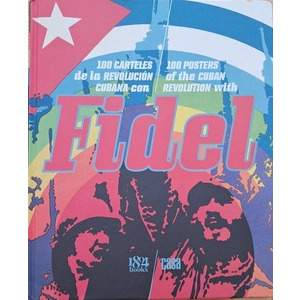
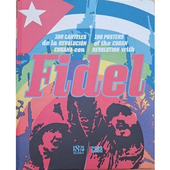
100 posters of the Cuban Revolution with Fidel
2026, pub 1804 Books
This book is a fascinating visual record of the Cuban Revolution, told through posters that draw on Fidel’s image, words and ideas. Fittingly, it is itself a US-Cuba collaboration, bringing together New York radical publishing house 1804 Books and Havana’s Casa de las Américas, with support from the Fidel Castro Centre in Havana and the Center for Cuban Studies in New York.
The posters have been curated by acclaimed Cuban graphic designer Pepe Menéndez, who also provides commentary on the works and their history. The collection is further enriched by contributions from US writer Alice Walker and celebrated Cuban poet Nancy Morejón.
See review below
£35.00 inc p&p
| Check Basket |
THE FIRST poster of the Cuban Revolution appeared on 1 January 1959. Its designer, Eladio Rivadulla, had not been commissioned to produce it – he simply sensed the importance of the moment. It marked the birth of Cuban revolutionary graphic art and was the first poster to depict Fidel Castro, capturing both his image and the ideas he represented. Rivadulla’s Fidel is 100 Posters of the Cuban Revolution with Fidel not a distant monumental figure, but meets us at eye level, almost as if we could have a conversation with him.
This book is a fascinating visual record of the Cuban Revolution, told through posters that draw on Fidel’s image, words and ideas. Fittingly, it is itself a US-Cuba collaboration, bringing together New York radical publishing house 1804 Books and Havana’s Casa de las Américas, with support from the Fidel Castro Centre in Havana and the Center for Cuban Studies in New York.
The posters have been curated by acclaimed Cuban graphic designer Pepe Menéndez, who also provides commentary on the works and their history. The collection is further enriched by contributions from US writer Alice Walker and celebrated Cuban poet Nancy Morejón.
Of course, during his lifetime Fidel Castro rejected the cult of personality, prohibiting statues and monuments in his likeness. And yet most of these posters used his image. Given Fidel’s achievement it was inevitable that over time the slogans and the posters would reflect a hint of idolisation, but mostly the posters tried to avoid the messianic and to convey his ideas, for example as an educator.
Manolo de los Santos, of the People’s Forum and 1804 Books, says in his contribution that rather than being deified, Fidel became a kind of “collective pseudonym.” The posters are the visual language of people identifying their struggle with their leader. In some posters Fidel is “yet another protagonist in the sea of his people.”
Many of the posters have no known author and were produced by Revolutionary Organising Committees in the ‘60s and displayed in workplaces and institutions. Some were designed by world-famous Cuban artist Raúl Martinez and other contemporary artists, but mostly the designers are much lesser known. The book is distinctly non-glossy, and not about the merits of individual artists or individual artworks; it is about how a society presented their leader and his ideas to themselves to help them make their world better.
De los Santos hopes it can inspire a younger generation “to engage with a symbol of rebelliousness and audacity that remains urgently necessary.” This sentiment is echoed by Abel Prieto, director of the Casa de las Americas, who describes the book’s aim: “To honour Fidel and bring him once again into the present.”
Review for CubaSi magazine Autumn 2026